



The federal authorities mentioned it’s deploying synthetic intelligence-assisted instruments and digital audit trails within the Nigeria Immigration Service (NIS) to strengthen border safety, detect suspicious migration patterns and maintain officers accountable for his or her choices, as a part of efforts to shut data gaps exploited by criminals.
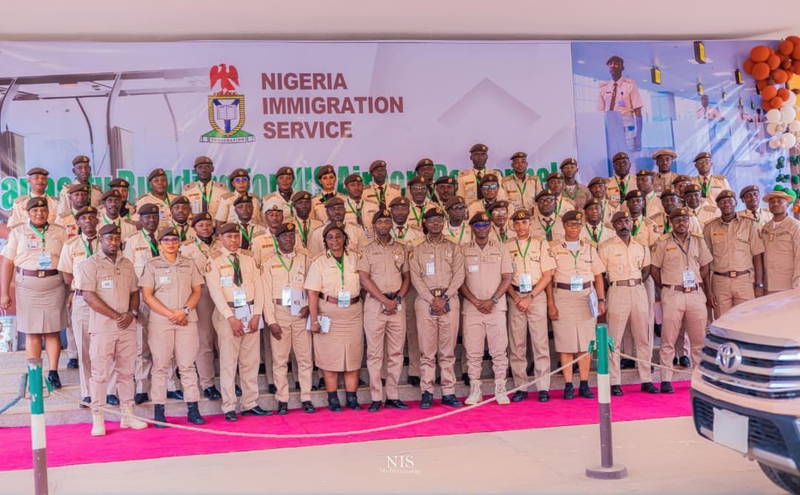
The Minister of Interior, Olubunmi Tunji-Ojo, disclosed this on Friday on the closing ceremony of a specialised coaching programme on border management and immigration administration on the NIS headquarters in Abuja, the place he outlined the federal government’s efforts to modernise immigration operations and strengthen coordination amongst companies accountable for nationwide safety.
Tunji-Ojo mentioned the immigration reforms fashioned a part of a broader governance initiative to attach data programs throughout companies beneath the ministry and cut back safety vulnerabilities created by disconnected databases.
He mentioned the federal government had developed a 10-year know-how roadmap and established a knowledge centre with a capability exceeding eight petabytes, supported by a photo voltaic farm that permits the information command and management centre to function off-grid.
According to the minister, the broader Centralised Interior Management and Administration System (CMAS) was designed to combine related data programs throughout the ministry, together with correctional and hearth service administration platforms, whereas bettering coordination with identification administration establishments.
He argued that managing migration in a rustic with greater than 200 million folks via analogue processes was not sustainable, notably when authorities wanted dependable details about the identities and standing of individuals getting into, leaving or residing in Nigeria.
Tunji-Ojo questioned official information that reportedly put the variety of international nationals working within the nation at about 40,000 when he assumed workplace, arguing that the determine illustrated the necessity for extra complete knowledge and stronger coordination amongst authorities companies.
“We got into a system where, by official records, we had maybe about 40,000 foreigners or whatever working in Nigeria. In a country of 200 million, that is not possible anywhere in the world,” he mentioned.
The minister questioned how authorities might successfully monitor international nationals and handle their affairs with out dependable details about their presence within the nation.
“When you do not have the data of those foreigners residing in your country, then how do you manage their affairs? How do you monitor them? How do you monitor someone that you don’t even know exists?” he requested.
He mentioned the federal government was addressing the weaknesses via knowledge harmonisation and technology-driven reforms meant to enhance coordination amongst companies accountable for migration administration, identification verification and nationwide safety.
Tunji-Ojo additionally cited the September 11, 2001 assaults within the United States as a warning in regards to the safety penalties of intelligence failing to succeed in related authorities due to gaps in data sharing.
He mentioned the administration of President Bola Tinubu was working to deal with such vulnerabilities earlier than they contributed to main safety failures, stressing the significance of connecting companies that generate and course of important data.
The initiative comes because the Nigeria Immigration Service has consolidated greater than 15 million migration information into its Border Control and Immigration Management System (BCIMS), integrating data beforehand held throughout separate platforms to enhance identification verification, border checks and the evaluation of potential safety dangers.
The integration of BCIMS with the Migration Information and Data Analysis System (MIDAS) is meant to offer authorised officers with a extra coordinated image of travellers’ identities, actions and potential dangers, enabling extra knowledgeable operational choices.
The reforms are anticipated to strengthen efforts to establish suspicious migration patterns and tackle identification fraud, migrant smuggling, trafficking in individuals and different transnational crimes that exploit weaknesses in data sharing amongst authorities establishments and border instructions.
.Tunji-Ojo additionally warned know-how distributors in opposition to withholding technical information from authorities personnel, declaring that the ministry would prioritise information switch to cut back dependence on exterior contractors.
He mentioned the federal government wished Nigerian personnel to amass the experience required to function and keep important programs as a substitute of leaving public establishments susceptible when distributors have been unavailable or unwilling to offer help.
“The era when any vendor will hold the service of government to ransom is gone,” he mentioned.
“If you cannot transfer knowledge, then you have no business in government business.”
The minister mentioned the initiative was meant to construct an immigration service able to growing native experience and finally helping different international locations with border administration and migration know-how.
He pledged continued funding in coaching, arguing that improved efficiency couldn’t fairly be demanded from officers who had not obtained the mandatory technical preparation.
Tunji-Ojo maintained that the federal government’s know-how investments have been a part of a broader effort to modernise public establishments, strengthen inside safety and set up programs able to delivering outcomes past the tenure of particular person officeholders.
He urged immigration officers to translate their coaching into measurable enhancements at their responsibility posts, whereas Nandap burdened that the credibility of the reforms would in the end depend upon how responsibly the know-how was used.
The central problem, she mentioned, was to strengthen Nigeria’s safety, facilitate respectable motion and make sure that border management choices have been supported by dependable data, skilled judgement and respect for travellers’ rights.
With greater than 15 million migration information consolidated right into a centralised platform, the federal government is in search of to rework border administration from fragmented, largely reactive operations right into a coordinated, intelligence-supported system.
The long-term success of the initiative will depend upon the accuracy of the information, the reliability of the know-how, the competence of educated officers and the effectiveness of safeguards in opposition to misuse of delicate data.
Speaking on the importance of the system, the Comptroller-General of Immigration, Kemi Nandap, mentioned officers’ actions on the platform may very well be reviewed via digital information, making them extra accountable for his or her actions and choices.
She warned that entry to the system should not be abused, stressing that officers had a accountability to guard delicate data and adjust to established procedures.
“Your access to this system is a position of trust, not a personal privilege,” she mentioned.
Nandap cautioned officers in opposition to sharing login credentials, accessing information with out authorisation or manipulating the platform to grant favours, settle private disputes or facilitate improper passage, warning that such conduct might appeal to investigation and sanctions.
“Fragmented records, isolated decisions and outdated methods cannot meet these demands,” she mentioned, including that efficient migration administration required linked data, competent personnel and accountable management.
The service can be deploying safe cell units to increase verification past mounted immigration terminals, permitting officers to conduct checks within the subject whereas sustaining confidentiality and knowledge safety requirements.
Nandap cautioned that mobility should not weaken safety procedures, insisting that officers should apply the identical safeguards to handheld units as they do to office-based programs.
She mentioned synthetic intelligence-assisted instruments would assist establish patterns requiring additional examination however should not be allowed to make remaining choices independently.
“No technology is infallible. Poor data produces poor analysis. Unchecked alerts cause harm,” she mentioned.
The Comptroller-General recognized accuracy, integrity, judgement, readiness and accountability as 5 non-negotiable requirements for the 87 officers who accomplished the specialised coaching.
Under these requirements, officers are anticipated to make sure that entries into the system are correct, right errors solely via authorized procedures, defend their entry credentials, keep assigned tools and escalate suspicious circumstances via established channels.
She additionally charged supervisors to make sure that educated officers have been correctly deployed, tools remained operational and operational experiences have been submitted as required.
Nandap mentioned the success of the programme can be measured by its influence on precise border operations moderately than the variety of officers educated or units distributed.
She recognized improved document accuracy, constant border checks, immediate escalation of alerts, dependable system availability and the lawful remedy of travellers as key indicators for assessing the reforms.
We’ve received the sting. Get real-time experiences, breaking scoops, and unique angles delivered straight to your cellphone. Don’t accept stale information. Join LEADERSHIP NEWS on WhatsApp for twenty-four/7 updates →