


In April 2026, Anaor Saawuan laid her eight-month-old granddaughter on a skinny mattress inside their makeshift shelter on the Anyiin Internally Displaced Persons (IDP) camp in Logo Local Government Area of Benue State, Central Nigeria.
The toddler had been vomiting and stooling for 2 days. She additionally had a fever. Grandma thought it was a teething drawback, so she gave her a cough syrup and tablets she purchased at a patent drugs store throughout the highway.
But when the vomiting and diarrhoea returned, she took the kid to a hospital exterior the camp, the place well being staff mentioned she wanted a blood transfusion.
“I had no money,” she mentioned. “And there was nobody to help me.”
She resorted to a standard treatment. However, at about 9 p.m. on 2 May, the kid died. She believes the kid may need survived if the close by clinic inside the camp had nonetheless been operational.
“There used to be a clinic here,” Mrs Saawuan mentioned, pointing in direction of a constructing contained in the camp. “Medicines were available, and treatment was free, until everything stopped.”

Her case illustrates the healthcare crisis at settlements for folks displaced by conflicts in Benue State, the place clinics are closed or poorly outfitted, medicines are in quick provide, referral methods are weak, and lots of households can not afford healthcare prices.
Another well being burden
Mrs Saawuan additionally has a younger grandson, who was identified with an inguinal hernia and referred for surgical procedure at a basic hospital. “We barely feed,” she mentioned. “How can I pay for an operation?”
Mrs Saawuan has once more resorted to herbs to handle his situation.

A dangerous being pregnant
A number of shelters away in the identical camp lives a pregnant 32-year-old lady, Naomi Teryen.
Her earlier pregnancies had been troublesome, she mentioned, involving extended labour and Caesarean sections.
But 5 months into her present being pregnant, she has little cash for normal antenatal care at a well being centre exterior the camp and has not had an ultrasound scan.
“I don’t have a job, and there is no proper healthcare service in this camp,” she informed PREMIUM TIMES.
Mrs Teryen mentioned she beforehand relied on the well being facility in the camp.
“When the hospital was available, we used to get medicine free of charge there,” she mentioned. “But now that the hospital has been closed, when we go to the health centre, we pay for medicine.”
Cost of a closed clinic
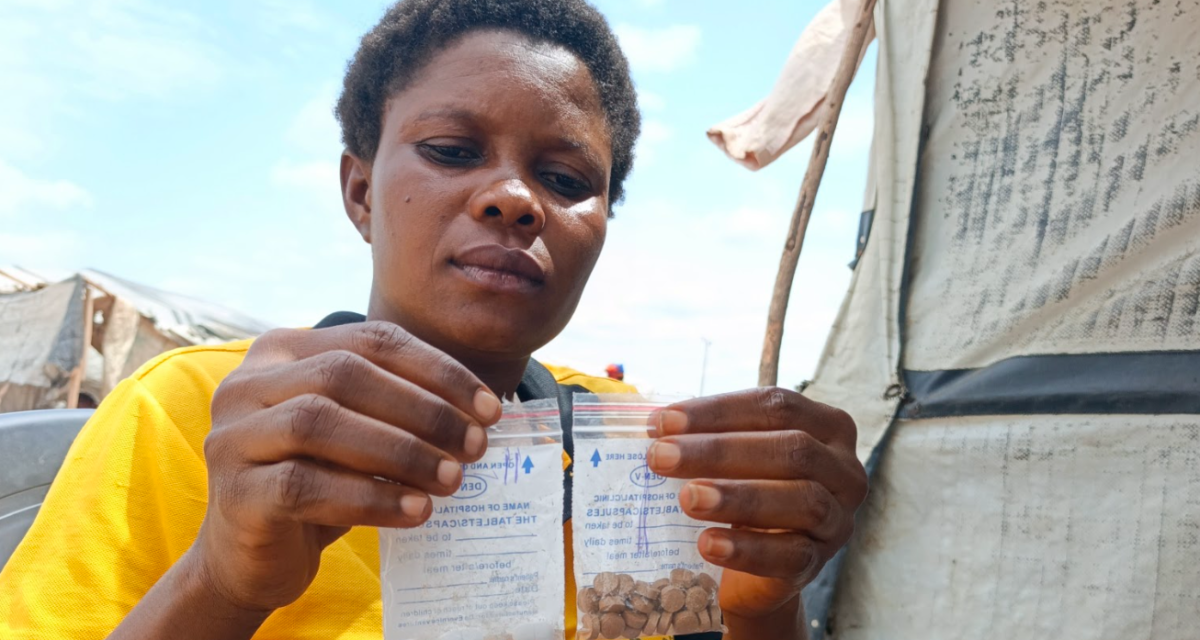
Mrs Teryen confirmed PREMIUM TIMES the medicines she obtained throughout an antenatal go to. They consisted of paracetamol and Multiple Micronutrient Supplements (MMS), which include nutritional vitamins and minerals supposed to forestall micronutrient deficiencies and enhance maternal and delivery outcomes.
The MMS dietary supplements are distributed by Nigeria’s public well being system with help from the federal government and growth companions, together with UNICEF.
They are supposed to be disbursed freed from cost. But Mrs Teryen alleged pregnant ladies from the camp are charged for medicines, together with MMS, throughout antenatal visits to the well being centre exterior the camp.
She mentioned that an antenatal go to to the European Economic Community Health Clinic (CHC) in Anyiin, a government-owned main healthcare facility in the group, sometimes prices her about ₦3,000. She recalled an event when she arrived on the centre with solely ₦1,000. “They told me to go back,” she mentioned.

Mrs Teryen’s husband makes wood crafts contained in the camp. But he usually sells nothing.
“Every time she gives birth, it is difficult. Sometimes we spend more than a week in the hospital,” he mentioned.
Terrence Akighir, a medical physician and UNICEF guide, informed PREMIUM TIMES the dietary supplements shouldn’t be offered to sufferers.
“MMS is supposed to be free,” he mentioned. “If somebody is taking advantage of that to sell the medicine, it should be looked into and stopped. These women do not have money. If they are paying for medicines that should be free, how will they meet their other healthcare needs?”
A UNICEF humanitarian report corroborates Mr Akighir’s claims amid the humanitarian crisis.
In its Humanitarian Situation Report No. 3, printed on 18 March 2026 and masking January to December 2025, the company mentioned that 8.8 million folks, together with 4.9 million kids, required humanitarian help, whereas 2.9 million folks had been internally displaced.
UNICEF reported that, beneath its First 1,000 Days Initiative, 489 pregnant ladies in Benue IDPs obtained free MMS between June and December 2025.
Clinic declines remark
PREMIUM TIMES contacted the European Economic Community Health Clinic in Anyiin for a response to the allegation. An official on responsibility mentioned she was not authorised to touch upon whether or not MMS had been being offered to sufferers and declined to supply additional info earlier than strolling away.

When the clinic closed
The healthcare crisis on the Anyiin IDP camp didn’t start this 12 months. It adopted the closure of a well being facility contained in the camp that had as soon as supplied primary medical care to displaced residents.
Helen Tsavwua, a former employee on the facility, mentioned the clinic was established by Médecins Sans Frontières (MSF), which supplied medical providers to displaced communities in Anyiin IDP on the top of the displacement crisis in 2018.
“When MSF was leaving, Victim Support Fund (VSF) took over until January 2021,” she mentioned. “When they left, the hospital was closed down.”
According to Ms Tsavwua, VSF continued to supply some medicines to help sufferers, however the absence of medical personnel meant that residents couldn’t reliably entry remedy.
“They were giving medicines, but there was no doctor to attend to patients,” she mentioned. “When children or women were sick, they would go there, but there was nobody to give them medicine.”
She mentioned the restricted remedy accessible on the time was additionally insufficient for some sufferers.
“Sometimes only malaria medicine or paracetamol would be given without even testing,” she mentioned.
A group well being employee on the Community Health Clinic, Anyiin, who beforehand labored on the camp facility, additionally attributed its closure to a scarcity of funding. The employee requested to not be named due to issues about potential victimisation.
According to the well being employee, MSF had supplied substantial help to the ability, together with medical personnel. Some of the docs and different well being staff who had labored beneath the organisation had been retained when its help ended, however sustaining the ability grew to become more and more troublesome.
“When MSF left, it became difficult to sustain the hospital,” the employee mentioned. “Medicine stopped coming in, and we were asked to return to our former posts.”
The employee mentioned the camp’s well being providers had depended closely on help from humanitarian organisations and different non-governmental teams.
“Most of the activities in the camp, especially health and food, were supported by NGOs,” the employee mentioned, including that the federal government’s position by the Benue State Emergency Management Agency (SEMA) was largely supervisory.
An deserted clinic
PREMIUM TIMES visited the previous clinic positioned inside the NKST Primary School, Anyiin, the place internally displaced folks nonetheless reside. The facility appeared abandoned, with its rooms locked and no well being staff or sufferers current. Its beige-and-black partitions had been chipped and peeling, whereas pale chalk inscriptions remained on the darkish metallic doorways. The concrete walkway was cracked and stained, bordered by naked reddish soil, whereas kids moved by the encompassing faculty grounds.

Camp residents mentioned medicines provided by non-profit organisations had been nonetheless stored contained in the locked facility. They mentioned the medicine remained inaccessible as a result of the constructing was closed and no well being staff had been accessible to take care of sufferers.
MSF exits Benue
PREMIUM TIMES contacted Abdulkareem Yakubu, area communication officer and spokesperson for MSF in Nigeria, for clarification on the organisation’s withdrawal and its implications for communities beforehand served by its groups.
Mr Yakubu mentioned he couldn’t touch upon the present scenario in communities the place MSF had ended its actions as a result of the organisation had closed its venture in Benue. He referred PREMIUM TIMES to MSF’s formal assertion on the closure, which he shared with the newspaper, saying the assertion contained the organisation’s place on its choice to go away the state.
In the statement, MSF mentioned it had determined to part out its medical humanitarian actions in Benue after six years of offering healthcare to internally displaced folks and host communities. The organisation mentioned primary healthcare and decentralised actions would conclude by the top of June 2024, whereas household planning and sexual and reproductive healthcare actions would stop by the top of Jul,y and complete sexual and gender-based violence care would finish in August the identical 12 months.
“MSF operations’ core mission is to provide urgent medical humanitarian assistance in emergency contexts, and we have a responsibility to ensure this capacity to provide assistance at a moment’s notice is maintained,” the assertion mentioned.
The organisation mentioned the choice was made after contemplating medical wants throughout Nigeria and the necessity to reinforce MSF’s response in different elements of the nation.
“We remain concerned for the safety of women and girls in Benue,” the assertion learn. “We will continue to advocate for more action by the Nigerian government and the newly arrived international organisations present in the area, to recognise the threat that SGBV poses to displaced people and to provide survivors with the necessary care.”
MSF mentioned that between May 2018 and March 2024, its medical groups performed 412,832 consultations and handled 223,871 sufferers in Mbawa, Ortese, Naka and Agagbe camps and host communities. The organisation additionally mentioned it admitted 1,731 folks following cases of sexual and gender-based violence in 2023.
“The arrival of international organisations is a hopeful signal that MSF’s drive to recognise the plight of displaced people in Benue state is being heard,” the assertion added.
According to MSF, a brand new clinic supported by UNICEF and WHO started working in three camps in late 2023. The organisation mentioned the event supplied some prospect of continued healthcare help for displaced communities after its withdrawal.
After MSF’s exit
At the Anyiin IDP camp, the results of MSF’s departure have continued to be felt by displaced residents. Julius Tema, chairman of the Anyiin IDP camp, mentioned the withdrawal of the organisation and the next closure of the camp’s well being facility had left residents struggling to entry primary healthcare.
“Our biggest challenges now are food and health,” he mentioned. “There are many sick people in this camp.”
He mentioned malaria remained widespread, alongside instances of hepatitis and different sicknesses.
“There was a hospital here before,” Mr Tema mentioned. “Today, that hospital is no longer functioning. We don’t have medicines anymore.”
With no functioning clinic, residents should search remedy exterior the camp, a burden many can not afford.
“When there is no medicine and no hospital inside the camp, people suffer,” he mentioned. “Some simply resort to herbs because they don’t have money to seek treatment elsewhere.”
Mr Tema mentioned pregnant ladies, kids and older residents had been significantly affected and appealed to the federal government and humanitarian organisations to revive healthcare providers.
“We need medicines. We need medical personnel. We need intervention before more lives are lost,” he mentioned.
Officials keep silent
The businesses liable for managing the IDP camps and offering healthcare to Benue residents didn’t reply to PREMIUM TIMES’ requests for feedback on the findings of this investigation.
During a phone dialog on 7 July, James Iorpuu, govt secretary of the Benue State Emergency Management Agency (SEMA), which oversees IDP camps, scheduled a gathering on the company’s headquarters in Makurdi for 9 a.m. the next day.
The reporter arrived earlier than the scheduled time and waited for greater than three hours. But when, at about midday, Mr Iorpuu emerged from his workplace, he ignored the reporter’s presence, entered his car, and drove away with out granting the interview or proposing one other time.
PREMIUM TIMES subsequently despatched inquiries to SEMA concerning the closure of the well being facility inside the IDP camp, the scarcity of medicines and medical provides, healthcare prices borne by displaced residents, emergency referral preparations, and help for well being staff serving the camps.
As of the time of this publication, the company has not responded.

The Benue State Commissioner for Health, Paul Ogwuche, additionally didn’t reply to repeated requests for remark. During a go to to the ministry on the Benue State Secretariat, Mr Ogwuche’s secretary requested a proper written interview request, which was completed.
As of the time of publication, the commissioner had not responded to the questions.
A wider well being crisis
The experiences documented in Anyiin are unfolding amid a protracted battle that has compelled lots of of 1000’s of individuals from their houses throughout Benue State.
The International Organisation for Migration’s Displacement Tracking Matrix (DTM) Round 18 recorded 464,543 internally displaced individuals in Benue, the best quantity throughout the North-central and North-west states lined by the evaluation.
About 376,000, or 81 per cent, had been dwelling in host communities, whereas roughly 88,000 had been in camps and camp-like settings.

Women and kids account for a lot of the displaced inhabitants, rising the necessity for maternal, reproductive and little one healthcare in the camps.
For many households, displacement has additionally meant the lack of farms, companies, and different sources of revenue.
An August 2025 assessment by the SEMA and the Internal Displacement Solutions Fund discovered that 96 per cent of displaced households surveyed wished to return to their communities.
The healthcare challenges are significantly important for pregnant ladies.
A examine printed in the National Library of Medicine’s PubMed Central (PMC), based mostly on analysis amongst pregnant ladies visiting PHCs in Benue State, reported a maternal mortality ratio of 1,189 deaths per 100,000 reside births.
The examine drew on knowledge from two cohorts masking 2015–2017 and 2020–2021. The reported ratio is greater than double Nigeria’s nationwide estimate and much above the Sustainable Development Goal goal of fewer than 70 maternal deaths per 100,000 reside births by 2030.
ALSO READ: Inside Benue IDP camp, where thousands live with stench
Infographic: Benue’s maternal mortality burden in contrast with Nigeria’s nationwide estimate and the Sustainable Development Goal goal
The 2021 Nigeria Multiple Indicator Cluster Survey (MICS) discovered that 59.1 per cent of births in Benue State had been attended by expert well being personnel.
Traditional delivery attendants assisted with 17.7 per cent of births, whereas kin or pals assisted with one other 17.2 per cent.
Health insurance coverage protection amongst ladies can be low. The similar survey additionally discovered that solely 2.5 per cent are lined by medical health insurance, leaving most households reliant on out-of-pocket funds for antenatal care, medicines, and emergency remedy.
For displaced ladies who’ve misplaced their livelihoods, these prices are compounded by transport bills and restricted entry to functioning well being services.
Newborns face important dangers as nicely. According to the 2021 MICS, one in each 56 kids born in Benue dies inside the first 28 days of life.
Preventable sicknesses, delayed care
Mr Akighir, the medical physician and UNICEF guide, mentioned many sicknesses affecting displaced households might be prevented or handled if care is accessible early.
He recognized malnutrition, malaria, and acute diarrheal illnesses as the main well being issues, significantly amongst kids.
“Malnutrition is one of the biggest problems we see,” he mentioned. “When children are malnourished, their immunity drops, and they become vulnerable to infections.”
He mentioned poor entry to protected water and sanitation can compound these dangers.
“Once they start drinking untreated water, acute diarrhoeal diseases become common,” he mentioned. “Many children also walk barefoot, exposing them to hookworm infestation, skin infections and other preventable diseases.”
Pregnant ladies face extra dangers when poverty and displacement delay their entry to care.
“Health-seeking behaviour is generally poor,” Mr Akighir mentioned. “Sometimes labour begins, and the woman delivers inside the camp because there is nobody to accompany her to a health facility. Others present very late, when complications have already developed.”
He mentioned weaknesses in the referral system can create additional obstacles, significantly for displaced individuals who weren’t registered once they arrived on the camps.
“Some of them came into the camps after registration had been completed,” he mentioned.
“When complications arise, and they are referred, they may face challenges accessing support because they are not captured in the system.”
Support, however gaps stay
Mr Akighir mentioned humanitarian organisations proceed to help maternal and little one healthcare in a few of Benue’s IDP camps, together with antenatal care, vitamin providers, remedy of childhood sicknesses and referrals for emergency care.
He mentioned one intervention had supported greater than 250 profitable deliveries.
However, such interventions haven’t eradicated gaps in entry to healthcare throughout the camps.
UNICEF’s 2025 humanitarian reporting shows that its well being response prolonged past vitamin help. By the top of the 12 months, the company mentioned important well being providers had reached displaced folks in 10 IDP camps and two host communities in Benue, with greater than 44,000 medical consultations and 16,000 childhood immunisations recorded.
The company nonetheless recognized gaps that continued to constrain the response, together with restricted authorities funding, shortages of important provides and weak coordination amongst authorities businesses.
For Mrs Teryen, whose child is due in September, these gaps have rapid penalties.
This reporting was accomplished with the help of the Centre for Journalism Innovation and Development (CJID).
Discover extra from Premium Times Nigeria
Subscribe to get the newest posts despatched to your e mail.