
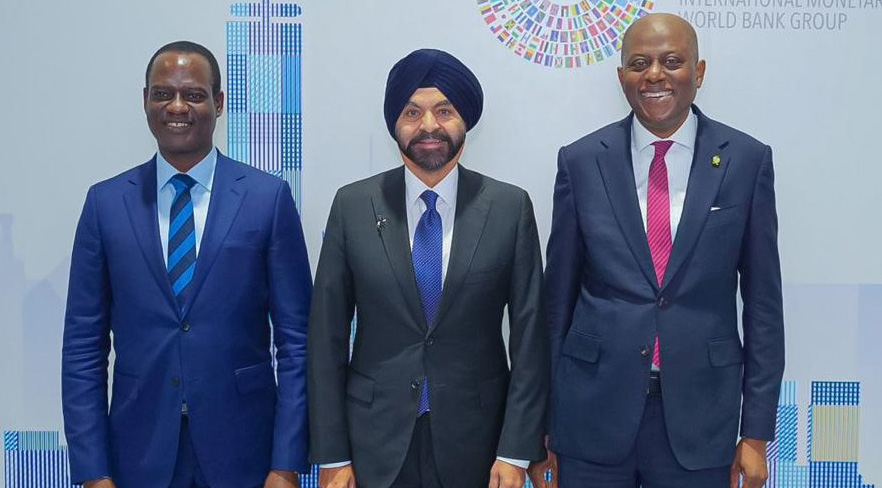

The Minister of Finance and Coordinating Minister of the Economy, Mr. Taiwo Oyedele, and the Governor of the Central Bank of Nigeria (CBN), Olayemi Cardoso, on Monday met with the President of the World Bank Group, Ajay Banga, on the sidelines of the continuing annual conferences of the International Monetary Fund (IMF) and the World Bank in Bangkok, Thailand.
This comes because the World Bank Group recognized synthetic intelligence (AI) functions in agriculture, healthcare, manufacturing, tourism and infrastructure as key to creating jobs and boosting productiveness in Nigeria and different African economies, urging governments to prioritise sensible makes use of of the expertise that handle native financial challenges.
In the assembly with Banga, Oyedele who leads Nigeria’s delegation to the week-long conferences and Cardoso met with the World Bank chief to evaluation the progress of Nigeria’s coverage reforms, and the following section of its agenda–turning macroeconomic stability into sooner progress, extra personal funding and stronger home revenues.
In an announcement issued by its Head, Media, Efe Ovuakporie the Ministry of Finance stated Banga recommended the progress of Nigeria’s reforms, pointing to the rise in personal capital inflows from about $300 million in 2023 to just about $6 billion in 2026, representing a “twentyfold increase.”
Oyedele highlighted the rising financial progress and famous that Nigeria’s tax-to-GDP ratio rose from about seven per cent to 12.5 per cent over the identical interval, including that this provides the federal government extra room to fund public funding with out resorting to deficit monetisation.
The assembly mentioned how Nigeria might make higher use of World Bank assure devices, ensures which might unlock financing for infrastructure and draw extra personal capital into the home market.
“Power infrastructure and human capital had been recognized as priorities for continued public funding, given their significance to enterprise competitiveness, productiveness and job creation. The assembly additionally harassed the standard of public spending, so that every naira delivers measurable financial and social returns.
“The meeting is part of the Federal Government’s wider engagement with development partners to lock in reform gains and attract new investment. As Nigeria moves from stability to growth, the priority is to turn stronger fundamentals into productive investment, more jobs and better living standards for Nigerians,” the assertion stated.
World Bank: AI Can Boost Jobs, Productivity in Nigeria, Other African Countries
Meanwhile, the World Bank Group has recognized AI functions in agriculture, healthcare, manufacturing, tourism and infrastructure as key to creating jobs and boosting productiveness in Nigeria and different African economies, urging governments to prioritise sensible makes use of of the expertise that handle native financial challenges.
Banga, stated the establishment was inserting job creation on the centre of its growth agenda, with specific emphasis on deploying smaller, sensible AI functions to strengthen companies, enhance entry to important providers and develop financial alternatives for younger folks.
Speaking on the World Bank’s flagship occasion, ‘Small AI: More and Better Jobs,’ on the ongoing IMF and World Bank Group Annual Meetings in Bangkok, Thailand, Banga stated creating economies might harness AI to enhance productiveness in sectors that already help tens of millions of livelihoods.
He recognized infrastructure, agriculture, major healthcare, tourism and manufacturing as 5 precedence sectors with important potential to generate employment, notably in economies the place small companies and casual financial actions account for a considerable proportion of livelihoods.
Banga stated the size of the demographic problem confronting creating economies made employment creation an pressing precedence for governments and growth establishments.
“I believe that the bank’s entire focus has to be on jobs for a very simple reason: 1.2 billion young people in the coming 15 years are going to become 18 years of age, so that could be a huge demographic dividend,” he stated.
He defined that the target was to make sure that younger folks might take part productively in society by way of formal employment, entrepreneurship and different financial actions.
“So, the word job does not mean working for a big company or a small company or as an entrepreneur. It’s being productive in society, having a sense of optimism and a sense of dignity that comes from earning and being a part of that system. That’s what we’re talking about,” Banga stated.
According to him, investments in infrastructure, schooling, healthcare and expertise growth have to be designed with employment outcomes in thoughts, whereas governments ought to set up the situations crucial for personal companies to take a position, develop and create jobs.
“The bank’s entire focus has moved towards that over the last few years. It’s not that we don’t build a school, or we won’t build a highway, or we won’t build a skilling center or a healthcare clinic. We have to do all those, but we got to do them with the perspective of job creation,” he stated.
Banga added that non-public capital would stay crucial to employment technology, whereas governments should present the infrastructure, governance and insurance policies required to draw funding.
“Governments enable, and the private sector generates between 75 and 85 percent of jobs in any country. That’s what we’re trying to do,” he stated.
For Nigeria and different African economies, the strategy locations emphasis on making use of AI to present industries, serving to native producers overcome productiveness constraints and enabling small companies to succeed in wider markets.
In agriculture, Banga stated AI-enabled instruments might assist smallholder farmers establish crop ailments, entry data on agricultural inputs, get hold of credit score and join with markets, thereby enhancing productiveness and competitiveness.
He famous that small farmers in creating economies usually struggled to compete due to restricted entry to expertise, cooperatives and different help techniques. Practical AI functions, he stated, might assist handle a few of these constraints and strengthen their participation in agricultural worth chains.
In healthcare, AI might allow native clinics to attach sufferers with distant medical doctors and specialists, serving to to bridge shortages of medical personnel and enhance entry to healthcare providers, notably in underserved communities.
The World Bank president additionally highlighted the employment potential of tourism, pointing to Thailand for example of an financial system that has developed the sector into an necessary supply of jobs.
Manufacturing, notably value-added manufacturing, was one other precedence, with Banga stressing the significance of making native employment by way of manufacturing and processing slightly than relying completely on the extraction of uncooked supplies.
He argued that smaller AI functions may very well be notably precious in creating economies as a result of they may handle sensible enterprise and service-delivery challenges with out requiring the assets related to extra refined AI techniques.
“The reality is that that large language models are estimated probably to create some degree of disruption in jobs in the developed world. By the time you get to middle-income countries and lower-middle-income countries, the actually the opportunity from small AI to build jobs and build productivity is enormous. That’s what we are trying to do, and that’s what the Jobs Council started out,” he stated.
The strategy comes as Nigeria and different African international locations face the problem of offering productive employment for rising youth populations whereas enhancing the competitiveness of home companies.
The World Bank’s place means that AI might help job creation whether it is deployed to strengthen present financial actions, enhance entry to data and markets, and assist enterprises develop slightly than merely exchange human labour.
However, the employment implications of AI stay a priority amongst policymakers, notably over whether or not productiveness beneficial properties will translate into ample new jobs and whether or not employees will purchase the talents wanted to adapt to altering labour-market necessities.
Meanwhile, the Managing Director of the International Monetary Fund (IMF), Kristalina Georgieva, and Singapore’s President, Tharman Shanmugaratnam, warned that AI might widen the hole between financial progress and employment if governments failed to arrange employees and economies for technological change.
Tharman stated financial progress alone was inadequate to ensure the creation of high quality jobs, citing China, India and creating Southeast Asia as examples of economies experiencing progress alongside comparatively weak employment technology.
“Growth is going to be critical to secure good jobs, but growth is not itself going to be sufficient to achieve those good jobs. And the evidence is already there. If you look at China, India, developing Southeast Asia, they’re growing quite well, but job creation is weak. So there’s already a divergence between growth and job creation, and AI is going to widen the divergence if we are too passive about it,” he stated.
He urged governments to deploy AI in ways in which help the creation of high quality jobs, allow employees to develop their capabilities and supply alternatives for profession development, slightly than permitting technological advances to deepen labour-market inequalities.
Tharman recognized manufacturing, inexperienced power and healthcare as sectors with persevering with potential to generate employment. He additionally known as for higher funding in expertise growth, internships, office expertise and utilized studying to arrange graduates for altering labour-market calls for.
Georgieva, on her half, highlighted the potential implications of AI for public funds, warning that adjustments within the composition of employment might have an effect on governments’ capability to generate income.
She defined that governments historically relied closely on taxing labourincome, however a shift in the direction of higher capital depth and lowered demand for some classes of labour might require a rethink of taxation and public income techniques.
“Think about the fiscal side of the story. Why? Because traditionally, governments would generate revenues by taxing mostly people. Well, if AI changes the structure of the labor market, and then there is less labor, more capital, what do we tax? How do we generate the revenues so governments can help play their most important role, which is help society adapt to the world of AI. If revenues are shrinking, they would be in a tough spot,” she stated.
She highlighted the necessity for governments to arrange for the fiscal penalties of technological change whereas investing in schooling, expertise growth and different measures to assist employees adapt.
Ndubuisi Francis and Nume Ekeghe
Follow us on: