


Among the tasks, he stated, had been photo voltaic dryers, warehouses, cassava processing centres and a poultry processing plant at Ajegunle Farm Settlement in Odeda Local Government Area. The poultry facility has the capability to course of 5,000 birds every day, equal to roughly 1.3 million birds yearly.
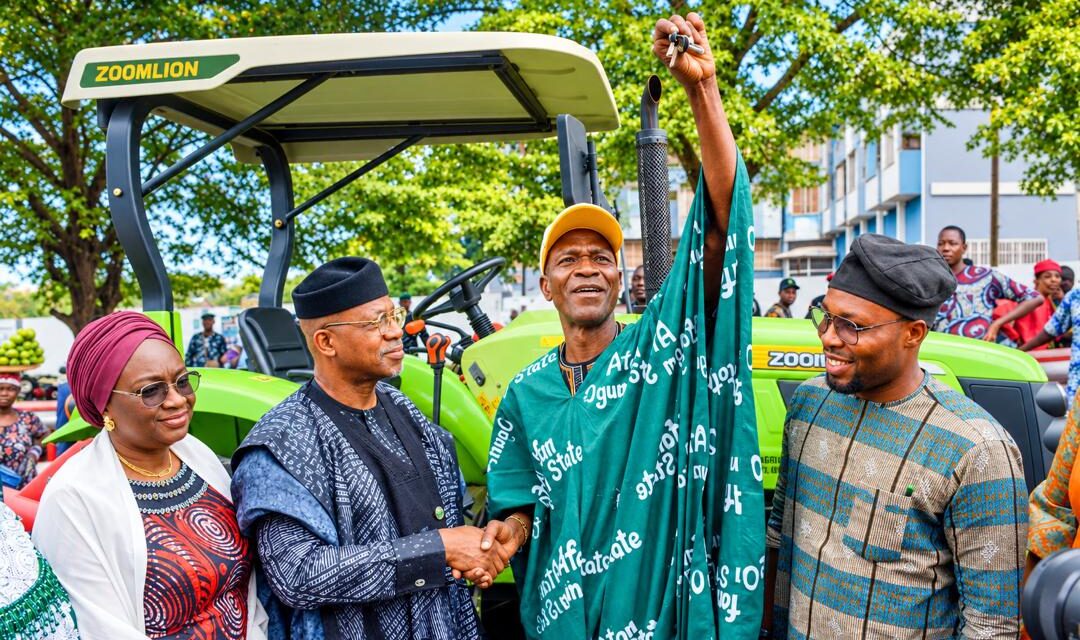
He added that the state had procured 39 tractors, 4 self-propelled harvesters and different agricultural tools to enhance mechanisation and cut back the burden of handbook farming.
On youth empowerment, Abiodun disclosed that greater than 200 younger folks had not too long ago obtained coaching in soilless farming by means of a partnership with Soilless Farm Lab, with start-up support offered to assist beneficiaries set up their very own agricultural enterprises.
He stated the administration’s goal was to develop native processing, retain larger worth throughout the state’s financial system and create employment alternatives throughout the agricultural worth chain.
“Our goal is to process more locally, retain greater value and create more jobs. We seek partnerships that create jobs, transfer knowledge, empower farmers and develop local capacity,” he stated.
The governor known as on traders to reap the benefits of alternatives in industrial farming, agro-processing, livestock manufacturing, aquaculture, mechanisation, irrigation, storage and cold-chain services, assuring them of the state’s readiness to support accountable agricultural investments.
He stated the administration was working in the direction of an agricultural financial system during which farming was worthwhile, agribusinesses thrived and rural communities prospered.
Abiodun additionally highlighted the Ogun State Farmer Information Management System, launched in April 2023, which has captured greater than 160,000 farmers and agricultural value-chain actors.
He defined that the platform was designed to support evidence-based policymaking, enhance the concentrating on of agricultural interventions and be sure that authorities help reached supposed beneficiaries.
“Under the Ogun State Economic Transformation Project (OGSTEP), agribusiness corporations bought over 283,000 tonnes of agricultural produce.
“Farmers organised into clusters also received capacity-building support and connections to off-takers. These measures have helped turn increased production into dependable income,” he stated.
The governor recommended President Bola Ahmed Tinubu for efforts to strengthen native fertiliser manufacturing and enhance farmers’ entry to important agricultural inputs. He additionally acknowledged the contributions of the First Lady, Senator Oluremi Tinubu, to initiatives supporting ladies farmers.
He stated the Ogun State Government would proceed to enrich federal agricultural initiatives by means of focused support for farmers, accountable funding and stronger market linkages.
Earlier, the Commissioner for Agriculture and Food Security, Bolu Owotomo, described World Food Day as a reminder that entry to nutritious and reasonably priced meals was basic to human dignity and sustainable growth.
He stated innovation was important to constructing a resilient meals system and known as for larger funding in ladies and younger folks by means of improved entry to land, finance, coaching, know-how and viable agribusiness alternatives.
Owotomo disclosed that greater than 12,000 farmers had benefited from coaching and agricultural inputs below OGSTEP.
He stated the most recent interventions targeted on three areas: digital empowerment by means of the distribution of Android telephones; mechanisation support by means of agricultural tools; and subsidised inputs for 2,000 rice farmers and eight,000 cassava farmers.
According to him, the enter support operates below an association during which beneficiaries contribute 30 per cent of the fee, relying on the class, whereas the federal government covers the remaining 70 per cent by means of its partnership with the International Fund for Agricultural Development (IFAD).
In his keynote handle, a former Deputy Vice-Chancellor of the Federal University of Agriculture, Abeokuta, Professor Kolawole Adebayo, stated Ogun State occupied a strategic place in the way forward for Nigeria’s meals system due to its agricultural potential and proximity to main client markets.
He famous that the state’s 1.2 million hectares of arable land supplied important alternatives for agro-industrial funding, stressing the necessity for forward-looking insurance policies and sustained dedication to improvements that will ship lasting advantages to the meals system.
Adebayo known as for an built-in transportation community linking rail, street, water and air transport to facilitate the environment friendly motion of agricultural produce, protect high quality and cut back post-harvest losses.
He recommended the state authorities for growing agro-industrial processing zones, bettering land-clearing providers for smallholder farmers and increasing entry to agricultural inputs.
He additionally recognized the Farmer Information Management System and the institution of the Nigerian Food Bank in Ogun State as initiatives that might strengthen the state’s contribution to nationwide meals safety.
The National Programme Coordinator of the Special Agro-Industrial Processing Zones Programme, Dr Kabiru Yusuf, represented by the National Agriculture Expert, Dr Louis Enaberue, recommended Abiodun for his support for the agricultural sector and urged beneficiaries to make efficient use of the tools and farm inputs.
Similarly, the South-West Coordinator of the Commodity Farmers Association of Nigeria, Prince Segun Dasaolu, acknowledged the state authorities’s interventions, saying they had been serving to to strengthen agricultural growth and support farmers throughout the area.
Speaking on behalf of farm settlers throughout the state, Rotimi Sogunle thanked the governor for supporting farming communities and described OGSTEP as a major intervention within the state’s agricultural sector.
The spotlight of the celebration was the symbolic presentation of tractors, agricultural tools, Android telephones, fertilisers, herbicides and different farm inputs to beneficiaries.