

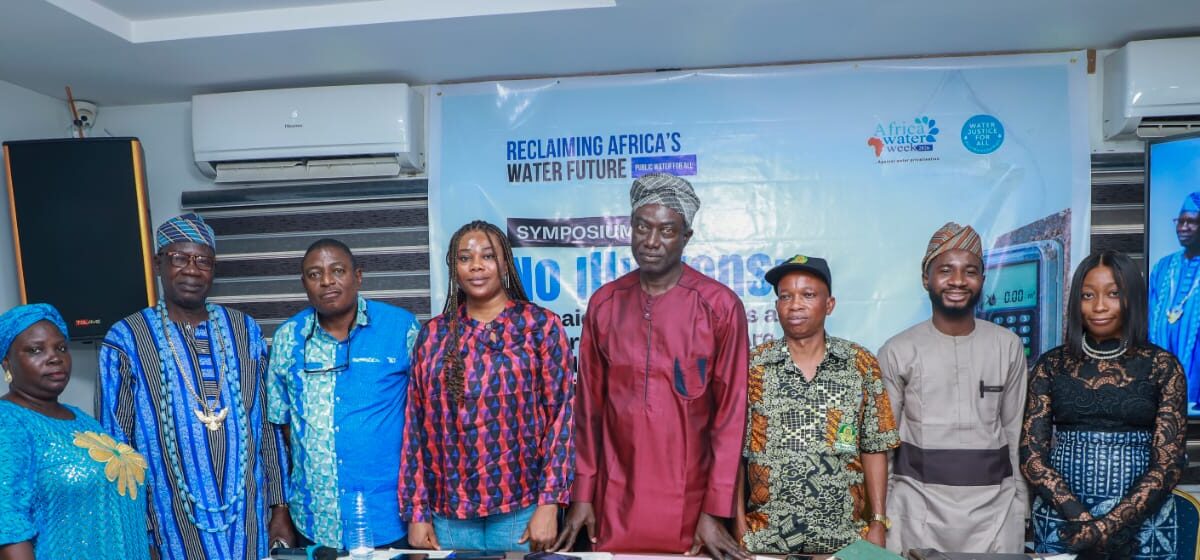

Community activists and a consultant of labour organisations have urged the Lagos State Government to spend money on public water infrastructure slightly than depend on non-public operators, warning that long-term concessions and pay as you go meters might make water much less reasonably priced for low-income households.
The teams spoke on Friday at a symposium in Ogba, Lagos, organised by the Corporate Accountability and Public Participation Africa (CAPPA) and the Our Water Our Right Africa Coalition as a part of the 2026 Africa Week of Action Against Water Privatisation.
The occasion was themed “No Illusions: Prepaid Water Meters and Water Privatisation Are Failed Models for Lagos, Nigeria.”
Speakers included Akinbode Oluwafemi, CAPPA’s government director; Zikora Ibeh, the organisation’s assistant government director; Rufus Olusesan, nationwide president of the Precision, Electrical and Related Equipment Senior Staff Association (PERESSA); Dagar Tolar of the Movement for Socialist Alternative; and Favour John, founder and government director of the Sustainable Futures Development Initiative (SUFDI).
Mr Oluwafemi warned that private-sector participation didn’t assure higher providers and will put water past the attain of poorer households.
“For profiteers, control of water is becoming the new petroleum,” he stated.

He argued that entry to water for ingesting, cooking, washing and primary hygiene mustn’t rely solely on a family’s skill to pay.
He argued that entry to water for ingesting, cooking, washing and primary hygiene mustn’t rely solely on a family’s skill to pay.
Activists query 20-year concessions
Mr Oluwafemi known as on the Lagos State Government to publish the phrases of its proposed water concessions, together with the monetary obligations, tariff preparations and protections obtainable to traders.
According to data introduced by CAPPA, the Lagos Water Corporation (LWC) has introduced a framework for standardised 20-year concessions, with cost-reflective tariffs topic to periodic critiques, foreign-exchange protections for traders and a 5 per cent royalty construction.
The proposed concessions cowl seven water services in Lekki, Akilo, Victoria Island Annex, Magodo, Abesan, Alexander and Apapa.
Speaking on the occasion, Ms Ibeh stated the company reported receiving 23 bids throughout 4 challenge heaps in May however had not recognized most well-liked bidders or printed the complete proposed agreements.
CAPPA stated it had requested the identities of bidders, analysis standards, feasibility research and award choices in March 2026.
The group additionally questioned the state authorities’s April 2025 settlement with Belstar Capital and ENKA for water infrastructure rehabilitation and growth. It raised issues concerning the choice course of, financing obligations and attainable results on tariffs.
Ms Ibeh cited a one-year memorandum of understanding signed in 2026 with China Harbour Engineering Company and Naston Engineering Nigeria Limited for a proposed water infrastructure programme inside the Lekki Concession Area.
The deliberate works embody transmission infrastructure beneath the Lagos Lagoon, distribution networks, metering and family connections.
The Lagos State Government had presented public-private partnerships as a solution to appeal to investment, rehabilitate water infrastructure and increase entry to dependable provide.
At a stakeholder engagement in August 2025, the Lagos Water Corporation stated the initiative was meant to deliver collectively public authorities, traders and growth companions to enhance service supply.
Activists name for rehabilitation of waterworks
Mr Tolar stated the federal government ought to handle the situation of present water infrastructure slightly than depend on private-sector participation to resolve the state’s water shortages.
He said that Lagos had main waterworks and 48 mini and micro waterworks, however their mixed output was insufficient to satisfy demand.
Citing figures he introduced on the symposium, Mr Tolar put the mixed manufacturing capability of the services, together with the Adiyan waterworks serving Lagos and Ogun states, at about 200 million gallons every day. He estimated that Lagos wanted no less than 500 million gallons a day.
The figures and operational charges he cited couldn’t be independently established from the knowledge offered on the occasion.
Mr Tolar known as for a complete “Water for All” plan that would come with rehabilitating present services, constructing extra waterworks and utilizing trendy expertise to extend manufacturing.
He stated the plan ought to account for future inhabitants development. He additionally questioned how a lot successive administrations had invested in water infrastructure since Nigeria returned to civilian rule in 1999.
“No form or version of privatisation will fix the water problem in Lagos or Nigeria,” he stated.
He cited electrical energy privatisation and private-sector participation in waste assortment as examples of reforms he believed had did not ship the anticipated advantages.
Communities bear the price of water shortages
Mr John stated analysis into group water infrastructure in Lagos confirmed that residents typically had to offer and preserve services that ought to serve the public.
Presenting findings from a analysis challenge on strengthening resilient public water providers, he stated many communities relied on water factors donated by councillors, spiritual establishments and people as a result of authorities services had been unavailable or poorly maintained.
He defined that group growth associations (CDAs) generally pooled cash to purchase water from tankers, pay electrical energy payments and restore pumps.
“In your community, for example, there’s no public water. There’s a situation whereby the CDA even organises to fund a water tanker sometimes,” he stated.
Mr John cited a group the place residents reportedly spent about N85,000 weekly on water, but the provision remained inadequate.
He proposed public-community partnerships that will give residents a job in managing services. Women and younger individuals, who typically bear a lot of the burden of fetching water, also needs to be represented in community-level choices.
“Water should be accessible and should be available and should be safe for every human consumption,” she stated.
Labour warns of job losses
Mr Olusesan stated staff had a direct stake within the proposed reforms, warning that restructuring and private-sector concessions might result in retrenchment, casualisation and the lack of employment advantages.
He urged the federal government to guard staff’ rights, regularise informal employees and provides commerce unions illustration on the boards of public water firms.
CAPPA stated the restructuring of the Lagos Water Corporation led to the disengagement of 425 contract staff in December 2023 and the dismissal of 391 everlasting employees on grounds of redundancy on 15 April 2024.
The organisation and labour teams challenged the selections, arguing that the workforce reductions weakened the capability of a public establishment liable for offering a vital service.
The company, nonetheless, attributed the restructuring to a personnel audit and operational necessities, based on Ms Ibeh.
Mr Olusesan criticised what he described because the promotion of market-oriented water reforms by worldwide monetary establishments, notably the International Monetary Fund and the World Bank.
He argued that insurance policies centred on value restoration, commercialisation and public-private partnerships might shift extra of the price of water provision to households.
Citing experiences in Ghana, Senegal and different African nations, he stated private-sector administration had not assured reasonably priced water for poorer communities.
The PERESSA president additionally proposed group water-monitoring committees to report leaks, monitor public faucets and maintain water authorities accountable. He advocated public-public partnerships, by way of which established public utilities might assist enhance different public water methods.
READ ALSO: Lagos govt water privatisation will deepen inequality, coalition warns
Prepaid meters increase affordability issues
Mr Oluwafemi famous that pay as you go water meters might lower off households when their credit score ran out, no matter their circumstances.
“When a meter cuts off supply because credit has expired, it cannot distinguish between leaking pipes or a family waiting for daily wages,” he stated.
He said that households going through unemployment, sickness or emergencies might lose entry to water after they had been least ready to deal with the implications.
“A policy that recognises purchasing power but disregards essential need is discriminatory in its effects,” he famous.
Ms Ibeh stated CAPPA had documented complaints from residents in Akilo and Baruwa about unreliable provide, delays in activating bought models, low water stress and discrepancies between funds and the water acquired.
She burdened that the complaints raised questions on whether or not advance fee essentially assured dependable service or larger accountability.
CAPPA argued that pay as you go metering couldn’t be separated from the broader debate over private-sector participation. It stated residents wanted to know who would management distribution, how providers could be funded and whether or not income safety would take priority over their wants.
CAPPA questions public session
Ms Ibeh stated the Lagos State Government’s transfer in the direction of private-sector participation in water provision predated the present administration of the Lagos Water Corporation however had gathered momentum by way of restructuring, procurement workouts and investment agreements.
She said that CAPPA had challenged the course since no less than April 2023, when it questioned the privatisation implications of a December 2021 memorandum of understanding between the company and the United States Agency for International Development.
She additionally cited partnerships involving the Resilient Water Accelerator, WaterSupport, Arup and the Global Development Incubator as a part of efforts to draw investment into the state’s water sector.
Ms Ibeh questioned a stakeholder workshop convened by the company in August 2025 to debate non-public investment in water provide.
According to her, the company had already invited proposals below procurement reference LSWC/BFOT/001/2025 for the rehabilitation, upgrading, operation and upkeep of mini and micro waterworks below a Build-Finance-Operate-Transfer association.
The submission deadline was 28 August 2025.
CAPPA described the workshop as a sham session, arguing that residents had been being requested to debate a coverage that had already superior by way of procurement slightly than being given a significant alternative to affect the selection of service-delivery mannequin.
The organisation known as for larger transparency in procurement and significant session with affected communities earlier than choices with long-term penalties had been made.
Discover extra from Premium Times Nigeria
Subscribe to get the newest posts despatched to your e-mail.